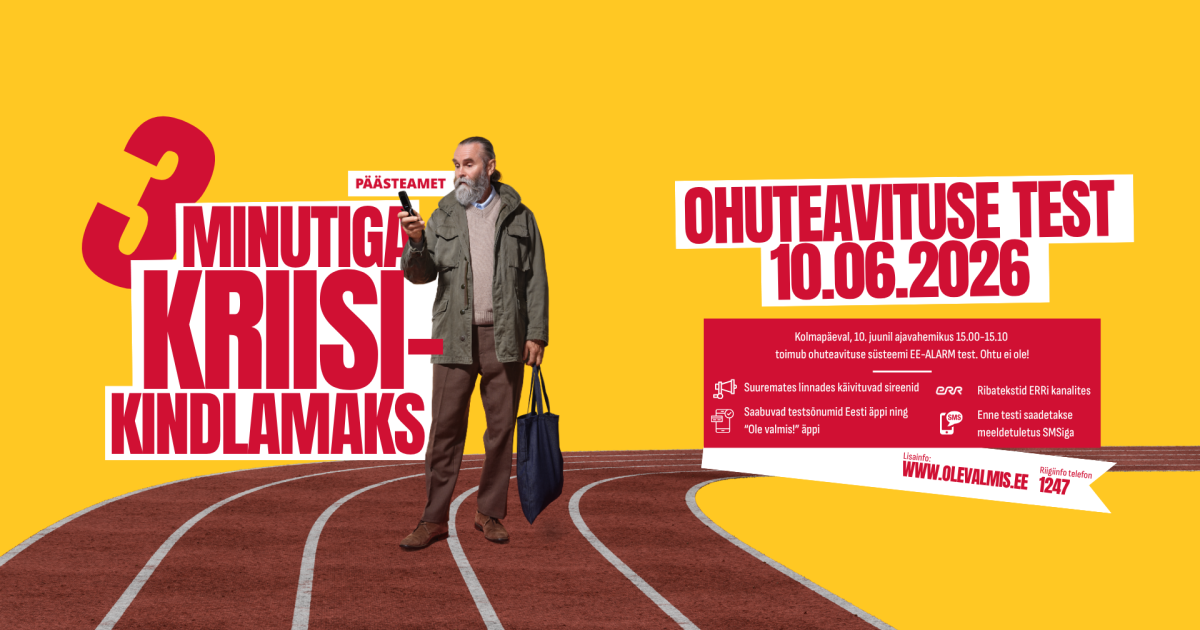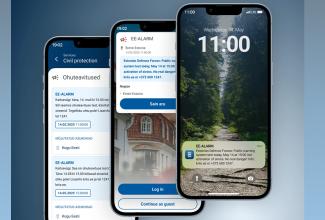
Between 15:00 and 15:10, the nationwide siren network will be activated using a real danger signal. Notifications will also be sent via the Eesti app, the “Ole valmis!” mobile application, and ERR channels. Around midday, an SMS message will remind you about the test.
On the test day, the Rescue Services invites residents, businesses, and institutions to take at least three minutes to make themselves and their families more resilient to crises. This includes considering how prepared they are for prolonged outages of electricity, water, and communications. During the test, it is also possible to practice sheltering in the location where one happens to be at the time of the test.
“Crises do not announce their arrival, and to cope as smoothly as possible in potential emergencies, it’s essential that everyone knows how to act and respond. The public warning system test is the perfect moment to think through and practice coping in these situations. This allows people to assess their own and their family’s awareness and, if necessary, improve their skills and knowledge. One skill that is certainly worth practicing is sheltering,” said Viktor Saaremets, Deputy Director General of the Estonian Rescue Services Agency. Find more detailed guidance on sheltering here.
In the same week as the test, the large-scale national defence exercise ILVES 2026 will take place, during which nearly 130 state agencies, local authorities, companies, and civil society organisations will practice operating in crisis situations. Many participating organisations will also practice sheltering during the public warning system test.
On June 8, a couple of days before the nationwide public warning system test, a technical test of the Eesti app and the “Ole valmis!” mobile application will take place. This means that users may receive several test notifications during the day. The testing is necessary to ensure that recent developments are functioning as intended and to prepare for the full system test.
After the nationwide public warning system test, feedback can be provided via an online survey on the website kriis.ee.
Testing of the EE-ALARM public warning system is necessary to assess developments in real-life conditions, identify shortcomings, and determine further development needs. Larger nationwide tests, during which sirens with a real danger signal are activated, are conducted regularly three to four times a year. During testing, the volume and coverage of the sirens are measured in seven locations, including the capital, to map areas where additional siren posts are needed.
This year, the public warning system will also be tested in autumn, on October 14.