Some Android users may receive technical test alerts
Technical testing will be carried out periodically from November 2026 onwards. In most cases, members of the public will not receive any test messages. However, in isolated cases, technical test alerts may be delivered to Android devices.
If a test alert has been received once on a particular Android device, the same device may also receive subsequent technical test alerts. These messages are part of the testing process and do not indicate any real danger.
Cell Broadcast will become part of Estonia's EE-ALARM public warning system in 2027
Cell Broadcast is a mobile-network-based warning technology that enables public warning alerts to be delivered to large numbers of devices within seconds. Alerts are displayed directly on the device screen, overriding other notifications and applications to ensure they are seen immediately.
In the event of an immediate threat, an alert may be accompanied by a loud warning tone and vibration, even when the device is set to silent mode or Do Not Disturb.
Cell Broadcast will complement Estonia's existing public warning channels, including sirens, location-based SMS alerts, the Eesti app, the "Ole valmis!" app and the channels of the national broadcaster ERR.
Test messages
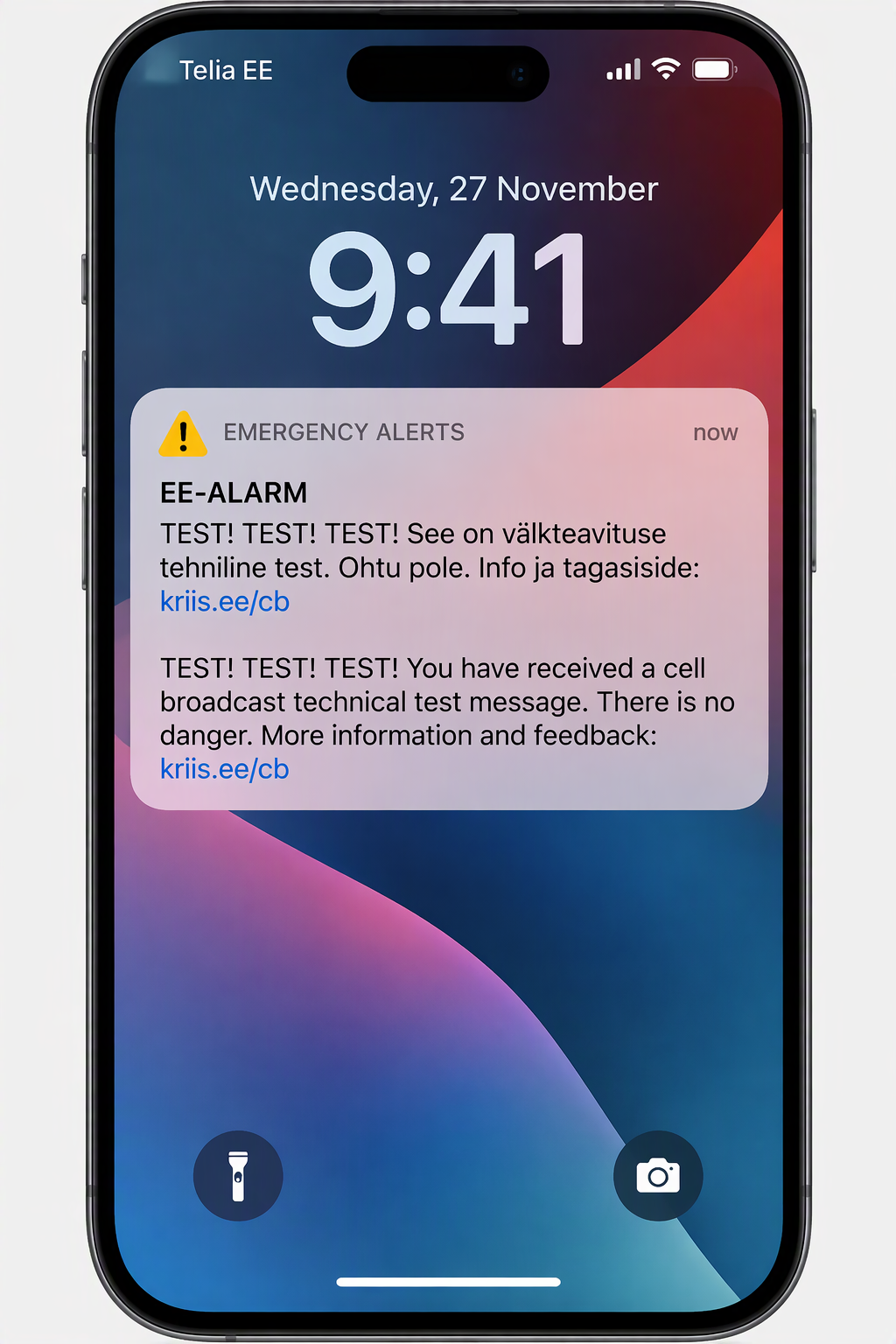
In estonian and in english
EE-ALARM
TEST! TEST! TEST! See on välkteavituse tehniline test. Ohtu pole. Info ja tagasiside: kriis.ee/cb
TEST! TEST! TEST! You have received a cell broadcast technical test message. There is no danger. More information and feedback: kriis.ee/cb
in Russian
EE-ALARM
ТЕСТ! ТЕСТ! ТЕСТ! Вы получили технический тест мгновенного оповещения. Опасности нет. Больше информации и обратная связь: kriis.ee/cb
Following the completion of technical testing, support for receiving Cell Broadcast alerts will be included in operating system updates released by Google (Android) and Apple (iOS). This capability will become available gradually on compatible 4G and 5G smart devices during the first months of 2027.
The Estonian Rescue Services Agency will inform the public when the relevant software updates become available and provide guidance on how to enable and use the service.
If you have received a technical cell broadcast test alert, please complete the feedback survey below.
Cell Broadcast | General Questions
Cell broadcast alerts will be introduced as a channel within the EE-ALARM public warning system in spring 2027.
International experience shows that during the first months following the introduction of this technology, cell broadcast alerts typically reach around 70% of smartphones. Within a year, coverage can exceed 90%, depending on the timing of Google and Apple software updates and users’ willingness to keep their devices up to date.
Cell broadcast is a mobile-network-based public warning technology that enables authorities to send alerts simultaneously to nearly all compatible smart devices located within a designated risk area.
Depending on the nature of the threat, alerts can be delivered either silently or accompanied by a loud warning tone and vibration, even when a phone is set to silent mode or Do Not Disturb. The technology enables warnings to reach very large numbers of people within seconds without placing additional load on mobile networks.
A cell broadcast alert does not appear or behave like a standard SMS message or app notification. Instead, it is displayed directly on the phone screen, overriding other notifications and applications. The alert may also be accompanied by a loud warning tone and vibration. The phone may produce a sound even when set to silent mode or Do Not Disturb.
The service is based on cell broadcast technology. Alerts are transmitted via mobile network base stations to devices located within a specific geographical area affected by the threat. Messages are delivered simultaneously to all compatible phones connected to 4G and 5G mobile networks within that area, regardless of the mobile operator being used.
This makes it possible to deliver critical information to large numbers of people very quickly, particularly during emergencies.
Unlike a standard SMS message or app notification, a cell broadcast alert is displayed directly on the screen, overriding all other notifications and applications. In the event of an immediate threat, the phone can notify the user with both sound and vibration, even when the device is set to silent mode or Do Not Disturb.
Users do not need to download a separate application to receive cell broadcast alerts. However, they will need to update their device’s operating system once the functionality becomes available.
Unlike SMS messages, cell broadcast alerts are delivered within seconds. App-based notifications require users to download the application, open it and enable notifications. The delivery speed of SMS messages depends on the number of recipients and the load on the mobile network at the time.
In addition, whether app and SMS notifications produce a sound often depends on individual user settings. As a result, people may not notice public warning alerts if their device notifications are muted. Cell broadcast technology, however, can deliver alerts with sound and vibration even when the device is set to silent mode or Do Not Disturb.
Like other channels within the EE-ALARM public warning system, cell broadcast alerts are used in situations involving an immediate or serious threat to the lives, health, property or environment of large numbers of people, where rapid public instructions are required.
Examples include:
- Dangerous chemical incidents
- Major fires involving toxic smoke
- Air threat warnings
- Other serious emergency situations
Generally, yes.
To maintain public trust and ensure that alerts are taken seriously, cell broadcast alerts are intended to be used only in situations where rapid public warning is essential to protect life, health, property or the environment.
Cell broadcast alerts issued for the highest threat level cannot be disabled.
However, during nationwide tests, users can avoid the accompanying sound and vibration by temporarily switching off their device or activating Flight Mode.
Unlike SMS alerts, cell broadcast requires both alert delivery and alert reception capabilities to be developed and tested.
To make the technology work, development work must be carried out by both the government and Estonia’s mobile network operators (Elisa, Tele2 and Telia). Close cooperation with Google and Apple is also required, as support for receiving cell broadcast alerts must be incorporated into their operating system updates. Neither governments nor mobile network operators can modify mobile operating systems themselves.
Creating this capability requires extensive development work and repeated technical testing to ensure that the technology functions reliably and as intended.
No. EE-ALARM cell broadcast alerts are transmitted through mobile network base stations to all devices within a designated area. Neither the government nor mobile network operators can see who has received the alert, nor do they collect device location data for this purpose.
Cell Broadcast | Sending and Receiving Alerts
To receive cell broadcast alerts:
- Your device must be connected to a 4G or 5G mobile network (devices in Flight Mode or switched off will not receive alerts)
- Your device must have the latest software version that supports Estonia’s cell broadcast service. The Estonian Rescue Service Agency will announce when the relevant software updates become available for download.
Yes, cell broadcast alert will be received on a mobile device regardless of which mobile network operator the person uses. Cell broadcast alerts operate on 4G and 5G networks. Devices that support only 2G networks cannot receive such alerts, with the exception of Android devices that are temporarily connected to a 2G network but are 4G- and/or 5G-capable and still able to receive operating system updates.
No. You do not need to download a mobile application to receive cell broadcast alerts.
However, to enable the technology, your phone’s operating system must be updated once the functionality becomes available in Estonia. The Estonian Rescue Service Agency will announce this through the media and official government information channels in early 2027.
In most cases, a cell broadcast alert will reach supported devices within a matter of seconds. The message is transmitted simultaneously via mobile network base stations to all compatible devices located within the affected area.
No. The device must be connected to a 4G or 5G mobile network in order to receive cell broadcast alerts.
Receipt of a cell broadcast alert depends on the availability of a 4G or 5G mobile signal. If a signal is available in the cellar, shelter, or elevator, the device can receive the alert.
Yes. Cell broadcast alerts are displayed even during an active phone call.
Alerts received during a call use a lower-volume warning tone so that they do not startle or overwhelm the user.
No. A switched-off phone cannot receive cell broadcast alerts.
If the device is switched on later, it may not display a cell broadcast message that was transmitted while it was powered off.
Yes. If a child has a 4G- or 5G-capable mobile phone that is connected to the mobile network and located within the affected area, they will receive the alert in the same way as an adult.
Parents and guardians are encouraged to explain in advance how public warnings work, what such alerts mean and how children should respond.
Yes. Cell broadcast alerts can be received on a switched-on smartphone even if no SIM card is installed, provided the device supports 4G or 5G networks and has the required operating system update installed.
A device will not receive or display cell broadcast alerts if it is switched off or set to Flight Mode.
The channels within the EE-ALARM public warning system are designed to complement one another both technically and operationally, ensuring that critical information can reach as many people as possible through multiple channels.
In addition to cell broadcast and app-based alerts delivered to smartphones, Estonia also uses SMS alerts, on-screen ticker messages on the channels of the Estonian Public Broadcasting service (ERR), and sirens.
If you know that a family member, elderly relative or neighbour uses an older device and may not receive public warnings, it is advisable to pass on important information through other means during an emergency, for example by calling them or knocking on their door.
Cell broadcast alerts are sent to all compatible devices located within the affected area, regardless of the origin of the SIM card.
All devices in the affected area will receive the alert simultaneously in Estonian and English. Users whose devices are set to Russian as the system language will additionally receive the alert in Russian. As a result, these devices will display the alert twice.
All devices located within the affected area will receive the alert in both Estonian and English.
Users whose devices are set to Russian as the system language will additionally receive the alert in Russian. As a result, these devices will display the alert twice.
In general, all compatible devices connected to 4G or 5G networks and running the required operating system version will receive cell broadcast alerts if they are located within the affected area.
However, depending on the size and boundaries of the alert area, it is possible that devices located at the very edge of the coverage area may not receive the alert.
Cell Broadcast | Devices
Cell broadcast alerts will be introduced as a channel within the EE-ALARM public warning system in spring 2027.
International experience shows that during the first months following the introduction of this technology, cell broadcast alerts typically reach around 70% of smartphones. Within a year, coverage can exceed 90%, depending on the timing of Google and Apple software updates and users’ willingness to keep their devices up to date.
Cell broadcast alerts will work on smart devices connected to a 4G or 5G mobile network and running the required operating system updates.
In general, cell broadcast alerts can be received by:
- Modern Android devices (running Android 11 or later)
- Apple iPhones with an iOS version that includes support for Estonia’s cell broadcast service
- Certain smartwatches connected to a mobile network
In general, cell broadcast alerts cannot be received by devices that:
- Use only a 2G mobile network (with the exception of certain Android devices using 2G connectivity that are capable of receiving operating system updates)
- Do not support cell broadcast technology, meaning they cannot receive the required operating system updates
- Have not been updated to the software version required by the device manufacturer
Detailed device and operating system requirements will be published once the joint testing programme involving Estonia’s mobile operators, Google and Apple has been completed.
Many smartwatches that support cell broadcast technology may also display alerts, provided they are paired with a supported smartphone and the manufacturer has enabled the functionality.
Option 1: Using the search bar
- Open Settings on your phone (usually indicated by a gear icon).
- Use the search bar at the top or bottom of the screen and type "Android" or "Software".
- Select "Android version" from the search results. This will take you directly to the relevant page.
Option 2: Through the Settings menu
Samsung devices
- Open Settings (usually indicated by a gear icon).
- Scroll down and tap About phone.
- Tap Software information.
- Check the number shown next to Android version.
Google Pixel, OnePlus, Xiaomi and other Android devices
- Open Settings (usually indicated by a gear icon).
- Scroll down and tap About phone or About device. On some devices, you may first need to select System.
- Tap Android version.
- The Android version installed on your device will be displayed there.
Last updated: 06.11.2026